Tuesday, March 15, 2016

The Panzer III: COMBAT USE


The Panzer III was used in the campaigns against Poland, France, the Soviet Union and in North Africa. A handful were still in use in Normandy, Anzio, Finland and in Operation Market Garden in 1944.

In the Polish and French campaigns, the Panzer III formed a small part of the German armored forces. Only a few hundred Ausf. A through F were available in these campaigns, most armed with the 37-mm (1.46 in) gun. They were the best medium tank available to the Germans and outclassed most of their opponents such as the Polish 7TP, French R-35 and H-35 light tanks.

Around the time of Operation Barbarossa, the Panzer III was numerically the most important German tank. At this time the majority of the available tanks (including re-armed Ausf. E and F, plus new Ausf. G and H models) mounted the 50-mm (1.97 in) KwK 38 L/42 cannon which also equipped the majority of the tanks in North Africa. Initially, the Panzer IIIs were outclassed and outnumbered by Soviet T-34 and KV tanks. However, the most numerous Soviet tanks were the T-26 and BT tanks. This, along with superior German tactical skill, crew training, and the good ergonomics of the Panzer III all contributed to a rough 6:1 favourable kill ratio for German tanks of all types in 1941.

With the appearance of the T-34 and KV tanks, rearming the Panzer III with a longer, more powerful 50-mm (1.97 in) cannon was prioritised. The T-34 was generally invulnerable in frontal engagements with the Panzer III until the 50 mm KwK 39 L/60 gun was introduced on the Panzer III Ausf. J¹ in the spring of 1942 (the gun was based on infantry's 50 mm Pak 38 L/60). This could penetrate the T-34 frontally at ranges under 500 metres (1,600 ft). Against the KV tanks it was a threat if armed with special high velocity tungsten rounds. In addition, to counter antitank rifles, in 1943 the Ausf. L version began the use of spaced armor skirts (schürzen) around the turret and on the hull sides. However, due to the introduction of the upgunned and uparmored Panzer IV, the Panzer III was, after the Battle of Kursk, relegated to secondary roles, such as training, and it was replaced as the main German medium tank by the Panzer IV and the Panther.

The Panzer III chassis was the basis for the turretless Sturmgeschütz III assault gun, one of the most successful self-propelled guns of the war, and the single most-produced German armored fighting vehicle design of World War II.

By the end of the war, the Pz.III had almost no frontline use and many vehicles had been returned to the factories for conversion into StuG assault guns, which were in high demand due to the defensive warfare style adopted by the German Army by then.

The following report written by Hauptmann Oehme, the commander of the 8.Kompanie/Panzer-Regiment 3, relates his experience in attempting to knock out T34 and KW-I tanks:

Combat Report for the Period of 11 through 17 August 1942:

At about 1800 hours, I received the order to drive to Jelnja to support the Gruppe von Bisehoffshausen with the Panzers that had just been repaired and the four Pz.Kpfw.IV (7.5 cm Kw.K.40 L/43) that had just arrived.

 The Panzer-Kompanie counterattacked JeInja, which was surrounded by our Panzers and taken under heavy fire by all of the Panzers. The front elements of the Russians pulled back and most of the houses in the village went up in flames. It was observed that two T-34s drove off in reverse out of burning sheds.

 As dawn broke, the Russians renewed the attack with tank and infantry forces. The tanks were immediately spotted and two T-34s on the road were knocked out at a range of about 300 meters. The rest of the tanks must have quickly retreated, as determined by the noise from their engines.

 During the evening hours of 13th August, the Russians again attacked with tanks and a few infantry riding on them. In spite of night falling, a further two T34s and a KW-I were knocked out of which two enemy tanks brightly burned, upon which the rest of the tanks turned back. The attack was repulsed.

During the night, the opponent with tanks took up positions in the depression by Shulebino and at dawn attempted to break through the woods by Point 208. At the same time eight to ten KW-I attacked on the road. Of these, two were knocked out in our position by the Pz.Kpfw.IV with a long gun at a range of 15 to 20 meters. The rest were convinced to turn back. It should be noted that it was necessary to use about eight Hohlraumgranaten (shaped charge shells) to set each of the KW-I on fire. At Point 208, three T34s managed to break into the position but didn't exploit the opportunity any further. The company commander of the infantry urgently requested Panzer support because these enemy tanks had hidden in the woods. One Pz.Kpfw.IV (7.5 cm Kw.K. L/24) and two Pz.Kpfw.III (5 cm Kw.K. L/42) were sent to the area where the enemy tanks had broken in.

In the afternoon, the Russians again attacked with strong tank forces. This time his attempt occurred south of the road. Several tanks landed in the swamp and remained stuck there. In the evening, these tanks were knocked out by the 5.Kompanie/Panzer-Regiment 3, while on the road four additional KW-I were knocked out by the 8.Kompanie. An 8.8 cm Flak gun had a large part in this last defensive battle. This gun was located in an alley south of the road, fell out when damaged by gun fire, and was pulled back.

On this day, several smaller Russian tanks were knocked out that had attacked separately. In addition a Pz.Kpfw.IV (7.5 cm Kw.K.40 L/43) was knocked out by a KW-I. One of the crew was killed, two severely wounded, and one lightly wounded.

Another Pz.Kpfw.IV (7.5 cm Kw.K.40 L/43) fought still another T34 but was itself knocked out. The Pz.Kpfw.IV immediately burned out. The commander and gunner were wounded, three of the crew were killed immediately. During these defensive actions from 11 to 17 August 1942, the 8.Kompanie knocked out 45 enemy tanks, of which 11 were T60s, and the rest T34s and KW-Is.

Thursday, September 17, 2015

Panzer III Colours 4


ART BY Carlos de Diego Vaquerizo


39- Pz. Kpfw. III Ausf. L (Sd. Kfz. 141/1), 60. Inf. Div.
(mot.), Southern Stalingrad, U. S. S. R., October 1942. During the spring of 1942, the 60 Infanteriedivision (mot.) (60th Motorized Infantry Division) received other that a few backup subunits, a Panzerabteilung from the 18. Pz. Div. The illustration shows a camouflaged armored vehicle with colors Braun RAL 8020, Grau RAL 7027 and Grün RAL 6007, having on its fenders the emblem of the 60. Inf. Div. (mot.), two small yellow crosses one on top of each other. This was one of the units that was annihilated in the Stalingrad siege. During the spring of 1943 several Infanteriedivisionen (mot.) were reformed, at least in theory, with a Panzerabteilung (armored vehicle battalion) a Panzerjägerabteilung (armored vehicle hunters) and an Aufklärungsabteilung (reconnaissance battalion), and from that moment on were renamed Panzergrenadierdivisionen; around this date a new formation was created; the 60. Pz. Gren. Div. a, which was finally called the Pz. Gren. Div. "Feldherrnhalle".

40- Pz. Kpfw. III Ausf. J (Sd. Kfz. 141), SS-Pz. Gren. Div. "Wiking", Caucasian region U. S. S. R., November 1942. Between September 1942 and November of that year, the Waffen SS "LSSAH", the "Das Reich", "Totenkopf" and "Wiking" divisions were upgraded to panzergrenadierdivisionen. As it has been mentioned, much war material that was intended for Northern Africa ended up on the Eastern Front, so in 1942 many vehicles with a tropical camouflage were seen on the Caucasian region. This Panzer III has been camouflaged before it got out of the factory with the official camouflage pattern approved in March, which is basically a Braun RAL 8020 base with Grau RAL 7027 spots occupying approximately 1/3 of the armored surface. The Swastika that identified the "Wiking", a "Sonnenrad" (a sun shaped rune), can be seen in the frontal right sided fender and in the rear left fender. On top of the spares wooden box on the turret there is a painted Swastika for aerial ID purposes.

Panzer III Colours 3


ART BY Carlos de Diego Vaquerizo


35- Pz. Kpfw. III Ausf. H (Sd. Kfz. 141), Pz. Rgt. 8, 15 Pz. Div., El Alamein, Egypt, October 1942. At first sight, the armored vehicles of the 15. Pz. Div. could be told apart from those of the 21. Pz. Div. by the numeral system: The first ones had a single big digit on both sides and on the back of the turret, while the second ones had three digit numerals. The "lonely" numeral in this case is a "6" the numeral identifies the company so this Panzer III belongs to the 2. Kp. of the II. Abt. The formation numerals can be seen in full on both sides of the frame in a smaller size. On the rear of the turret, on top of the division insignia, we can see the emblem of the Pz. Rgt. 8, a "Z" shaped rune reversed and lying down. This motif was called "Wolfsangel". Some armored vehicles in this unit had the top of the rear wooden box behind the turret painted red in order to be properly identified by fellow German aviators.

36- Pz. Kpfw. III Ausf. N (Sd. Kfz. 141/2), sch. Pz. Abt. 501, Kairouan, Tunisia, January 1943. In the Stab of this schwerepanzerabteilung we could find the Tiger "01" and "02" and a leichte Zug (light squad) with eight Panzer III's armed with a 75mm gun and numbered "03 to "10". The Panzer III arrived to Northern Tunisia painted with Braun RAL 8020 paint, a color tone which was not appropriate for this region with lots of green vegetation, so most vehicles were covered up with green paint, although in some cases only large green spots were painted. It makes sense to assume that we're dealing with Grün RAL 6007, but Feldgrau RAL 6006 and even Olive Drab paint
(captured from US forces) could have been used. The insignia for this unit; a lurking tiger, can be seen in the front right by the drivers' sight

37- Pz. Kpfw. III Ausf. M (Sd. Kfz. 141/1), 4./SSPz. Rgt. 3, SS-Pz. Gren. Div. "Totenkopf", Jarkov, U. S. S. R., March 1943. The Heer armored vehicles' divisionary emblems were usually painted yellow, but the Waffen SS vehicles were painted white. This Panzer III with white Weiss RAL 9001 camouflage paint, has its division emblem (a skull) right by the drivers' sight. The 4. Kp. from the SS-Pz. Rgt. 3 was a schwere Panzerkompanie (heavy armored vehicle company), and was equipped from the start with nine Tigers and ten Panzer III, but in May 1943 it was reduced to six Tiger and was reorganized as the 9. Kp.

38- Pz. Kpfw. III Ausf. M (Sd. Kfz. 141/1), 8./SS-Pz. Rgt. 2, SS-Pz. Gren. Div. "Das Reich", Jarkov, U. S. S. R. March 1943. The 8. Kp. from the SS-Pz. Rgt. 2 was a schwere Panzerkompanie which as it was customary and due to the slow manufacturing process of Tiger armored vehicles, had at first ten of these and twelve Panzer IIIs. The commander of this vehicle died in combat in March the 14th 1943 while conquering back Jarkov. Towards the end of that month, the company had some days off to get some provisions and recover from battle, and crews wrote the name of their fallen companion on both sides of the turret. The division emblem a "Wolfsangel", can be seen right by the drivers' sight and on the rear plank of the vehicle's frame. On top of the factory painted Gelbbraun coat, thin irregular lines of Dunkelgrau have been painted.

41- Pz. Kpfw III (FI) Ausf. M (Sd. Kfz. 141/3), Pz. Rgt. 11, 6. Pz. Div., Kursk, Southern Sector, U. S. S. R., July 1943. For the offensive that took place in the Kursk peninsula and with the purpose of confusing the Russian secret services, the Germans changed their insignias on every division that was to be a part of this offensive. The new insignias were simple geometric figures. The new one for the 6. Pz. Div. was a reversed double "T" with uneven arms; it was usually painted on all four sides of the vehicle and was simultaneously used along with a small four armed star, although this star was only painted on the front and back of the vehicles' frame. The system for identifying the different units of this division was to paint the abbreviated form of the commander's family name. For example the commander of the Pz. Rgt. 11 (only the second battalion was available here) was Von Oppeln- Bronikowski, his armored vehicles were painted with the letters "Op". The Flammpanzer (armored vehicle with flame thrower device) portrayed in this color profile has been camouflaged with the color pattern of 1943: Dunkelgelb RAL 7028, Olivgrün RAL 6003 and Rotbraun RAL 8017.

42- Pz. Kpfw. III Ausf. M (Sd. Kfz. 141/1), SS-Pz. Rgt. 3, SS-Pz. Gren. Div. "Totenkopf", Kursk, Southern Sector, U. S. S. R., July 1943. The temporary insignia for this division of the Waffen SS in the "Zitadelle" operation was a "Dreizackrune" or trident shaped rune: Three vertical bars painted in either white or black paint on the front and back of the vehicles. In spite of having three authorized battalions, the SS-Pz. Rgt. 3 only had two, with three companies each. This armored vehicle has numerals "II5" on both sides and the back of the turrets' shielding, indicating that this vehicle belongs to the Stab of the II. Abt. Camouflage consists of a series of irregular Olivgrün paint gun strokes on top of the factory painted Dunkelgelb.

Panzer II Colours 2


ART BY Carlos de Diego Vaquerizo


31- Pz. Kpfw. III Ausf. F (Sd. Kfz. 1941), Pz. Rgt. 2, 1. Pz. Div., France, June 1940. In 1940 this division took the oak leaf as their distinctive, a motif that was usually drawn in the front and rear of the armored vehicles' turret. The armored vehicles of the Pz. Rgt. 2 could be told apart from those of the Pz. Rgt 1 thanks to a painted dot after the formation numerals. Some units had a white cross for aerial ID purposes on top of the turret, a marking that was sometimes accompanied by a rectangle in the same color painted on top of the motors' cover.

32- Pz. Kpfw. III Ausf. E (Sd. Kfz. 141), Pz. Rgt.
31, 5. Pz. Div., Balkans, May 1941. The emblem that the OKH gave to this division in 1941 was an "X" which the armored vehicles had painted in the front, on both sides and on the back of the frame. The Pz. Rgt. 31 had a particular insignia named "Rot Teufel" (Red Devil) painted on both sides of the turret. This armored vehicle has its tactical numerals painted only on both sides of the frame; on the back of it we see a stencil with five small digits; these are the vehicles' frame number, in red.

33- Pz. Kpfw. III Ausf. G (Sd. Kfz. 141), Pz. Rgt. 5, 21. Pz. Div., Sidi Rezegh, Libya, November 1941. Under the brief and worn Gelbbraun RAL 8000 coat, we can see the factory painted Dunkelgrau RAL 7021 of this Panzer III. On both sides of the turret and on the "Rommelkiste" (Rommel box) screwed to the back of it, we can see painted white the numerals that tell us that this is the third armored vehicle from the first section of the first company. The Afrikakorps palm tree can be seen on both sides of the frame, and on the back of it we can see this motif right by the division insignia. Both motifs are also painted on the frontal armored plank, between the drivers' sight and the machine gun, although partially concealed by some spare track links set there to "increase armoring".

34- Pz. Bef. Wg. III Ausf. E (Sd. Kfz. 267), Pz. Rgt. 5, 21 Pz. Div., Bir Hakeim Libya, May 1942. This Panzerbefehlswagen (commanding armored vehicle) repainted Gelbbraun does not have its division emblem, but it does have the DAK palm trees. These motifs have been painted with the same color used for camouflage, while the crosses and numerals are white with hollow (unpainted) inside. This type of vehicle was equipped with several pieces of radio equipment, and because the lack of room, its turret was fixed (not moveable) and the gun was a decoy as well; after having lost the fake weapon on a fight, crews have placed a piece of wood to accomplish the function of the previous one.

Panzer II Colours 1

 ART BY Carlos de Diego Vaquerizo


29- Pz. Kpfw. III Ausf. L (Sd. Kfz. 141/1), sch. Pz. Abt. 502, Tortolowo U. S. S. R., September 1942. Heavy armored Tiger vehicles were manufactured slowly, so in the schwere Panzerabteilungen, (Independent battalions of heavy armored vehicles) a few Panzer III's were included. At some point in this year, in the Stab of the 1. Kp. there were Tigers "100" and "101", while vehicle number "102" was a Panzer III that was replaced in October of that year for a Tiger. The color of this vehicle once it got out of the factory seems to be one of the light grays employed by the Luftwaffe, but it could also be Grau RAL 7027; the unit that the vehicle was entrusted to, painted some Feldgrau RAL 6006 camouflage spots. The battalion insignia, a mammoth drawn in a white outline, can be seen right by the machine gun in the front and on the back of the turret. The style in which the Balkenkreuz is painted is quite interesting because of the unusual color array.

30- Pz. Kpfw. III Ausf. J (Sd. Kfz. 141/1), Pz. Rgt. 15, 11. Pz. Div., southern sector of the Eastern Front, U. S. S. R., July 1942. The official distinctive of this division was a circle divided by a vertical bar, which was usually painted on all four sides of the armored vehicles. This unit also employed another symbol; a ghost yielding a sword and reclined on the front of a vehicle in motion. The motif was painted on both sides of the frame and in the large box that most armored vehicles had in the back. The Pz. Rgt. 15 was known for painting on its vehicles formation numerals with only two digits: the first one indicated the squad and the second one the position of the armored vehicle inside the squad. On top of the Grau RAL 7003 base coat, elongated Grün RAL 6007 spots have been painted to camouflage the vehicle.

Tuesday, August 11, 2015

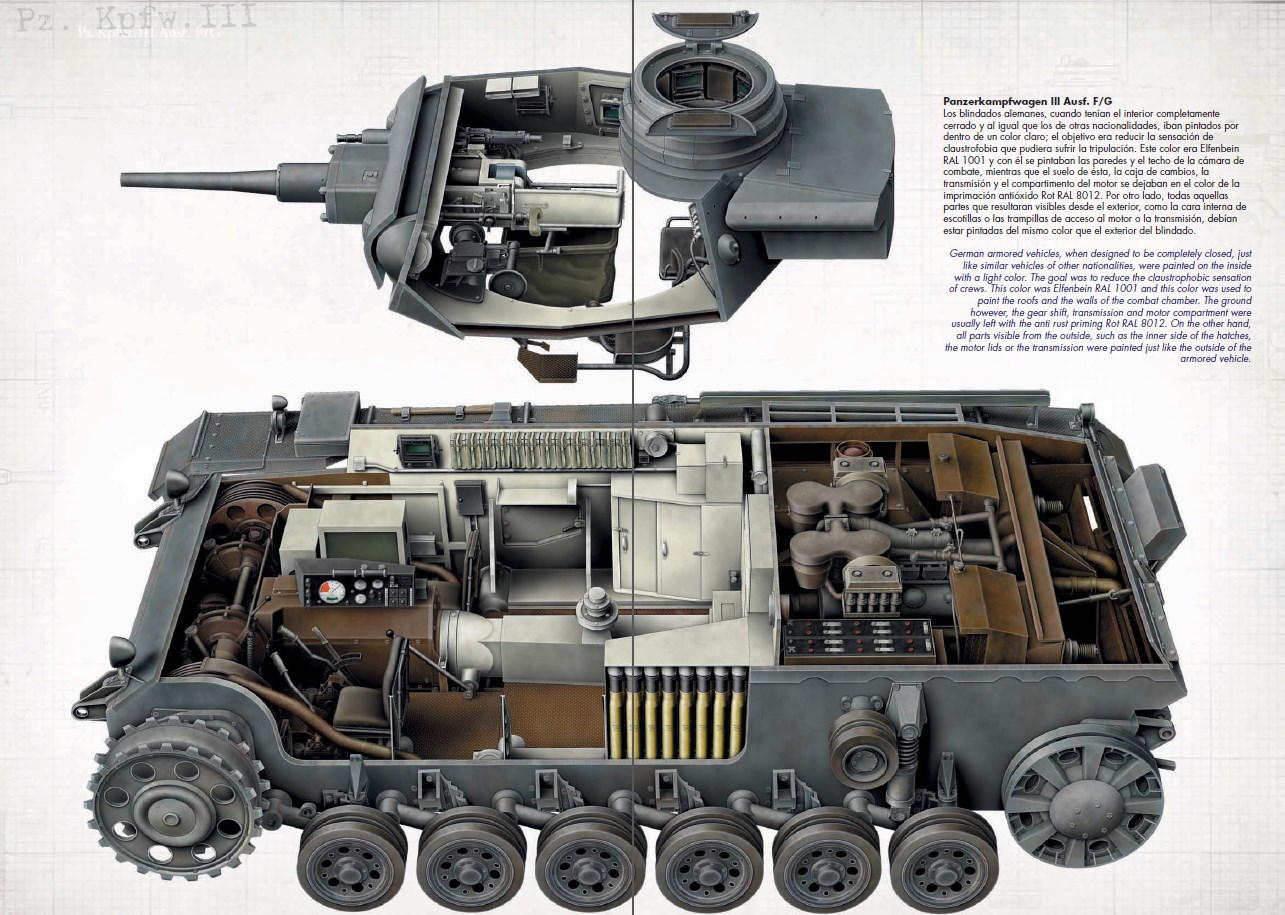
Cutaway - Pz.III


ART BY Carlos de Diego Vaquerizo


The Panzer III crew consisted of five men with two in the front of the hull including a driver at the left and a radio operator/hull machine gunner at the right. Up in the turret, the gunner sat to the left of the main weapon in typical German style, a loader worked the gun on the right side, and the commander sat elevated at the rear with the use of a cupola over his head for battlefield observation. Both the gunner and commander sat in padded seats suspended from the turret ring, rotating with the gun. But the loader had the use of a small fold down seat attached to the back firewall and typically worked standing up on the hull floor with his seat stowed. Most of these Ausf. E and F panzers were manufactured between 1938 and 1940 by Daimler-Benz, Maschinenfabrik-Augsburg-Nuernberg (MAN), and Henschel & Sohn, and together these firms produced 96 Ausf. E and 435 Ausf. F vehicles. The basic interior layout of the Pz. III would remain unchanged throughout the remainder of the production run but most of the major components would continue to improve, particularly up in the turret, as experience was gained in combat.

Unlike the early 3.7cm gun, the 5cm weapon and coax were protected behind an external mantlet. But in these models there were two viewing flaps in the mantlet, one on each end, and both of them are visible here. The additional right flap allowed the loader the same unrestricted view out the front of the tank as the gunner had. Notice the lead weight attached to the rear of the recoil guard to help balance the barrel heavy weapon.

The 5cm gun fired three ammo types. The high explosive (HE) was known as Sprenggranate 38 (Sprgr. 38), which was nose fused for impact detonation. The second type was an armor piercing capped shell of the typical German penetrating and bursting type called Panzergranate 39 (Pzgr. 39). The piercing cap on the end of the projectile helped reduce shattering upon contact with the target. The third type was Panzergranate 40 (Pzgr. 40) and this was a light weight projectile with a very heavy tungsten carbide core. Sometimes known as armor piercing composite rigid (APCR), this projectile reached a very high muzzle velocity at close ranges due to its light weight, but its velocity decreased rapidly at distance for the same reason. Because tungsten was at a premium in Germany, this shell was never offered to tankers in abundant quantity, but when battling at close quarters the Pzgr. 40 was a powerful armor piercing shot.

The Pzgr. 39 was one of a number of German bursting AP shells (called "Supercharged" by the Allies) which were particularly effective against Allied tanks where ammo was often stored unprotected inside the hull or turret. This was because the Pzgr. bursting charge detonated just after penetration, causing extensive internal fires and ammunition explosions with subsequent serious injury or death to the crew. On the other hand, Panzer III ammo rounds were stored in armored cabinets (4 to 6mm thick) below the turret ring, and Allied AP rounds that managed to penetrate the external armor skin were less likely to set them off. This was because the damage caused by most allied solid AP shells was restricted to the kinetic energy left in the round after penetration.

The next major changes in the evolution of the Pz. III centered on yet another increase in armor thickness to 30mm, requiring a new driver's visor 30 and an improved KFF2 periscope in the new Ausf. G tanks. With an improvement in the turret wall design to provide more room inside, an improved cupola was also added, the same cupola that was also mounted on later Pz. IV tanks. As with the mid production cupola mentioned earlier, the late style cupola required only one lever to open and close the upper and lower shutters that protected each of the cupola's five viewing blocks. But now the shutters were smaller, only the width of the view opening, and the operating lever inside was made to fit into détentes that fixed the shutters fully opened, half opened, and fully closed. Although the first batches of these new Ausf. G and J tanks were originally built with the 3.7cm guns, all later vehicles of these types were fitted with the KwK38 L/42 5cm weapons. By the end of 1942, most of the earlier Panzer III tanks that were still in service had been updated with the 5.0cm gun and very few photos show vehicles with the smaller caliber weapon from then on.

The short barreled 5.0cm L/42 was not powerful enough to penetrate many of the Soviet tanks they encountered during their Blitz into Russia and the longer KwK39 L/60 gun was substituted for the shorter weapon at the factories during the Ausf. J production run. Although the gun breech of both the L/42 and L/60 guns is identical from inside the vehicle, the longer ammo rounds of the later gun required some rearranging of storage in the hull and a reduction of numbers. Those vehicles with hull side escape hatches could store around 84 of these longer rounds while later Ausfs., with the hatches deleted, had room for 98.

Friday, July 17, 2015

Sturmhaubitze 42, Sd.Kfz 142/2 Late-Production


In October of 1942 Sturmhaubitze 42 was produced by Alkett, its design was based on Stug III Ausf F and F/8's chassis and it was armed with 105mm StuH 42 L/28 (L/30) howitzer. From 1943 onwards StuH 42 was built on Ausf G's chassis. Vehicles of this type were modified in the same way as Ausf Gs were. Early vehicles were fitted with muzzle brakes but since September of 1944, it was decided that it wasn't needed.

In August of 1940, Sturmartillerie units were reorganized into Abteilungen (battalions) with 18 assault guns in three batteries (with 6 assault guns each). In early 1941, the battalions were renamed - Sturmgeschuetz Abteilungen and batteries to Sturmgeschuetz Batteries. In March/April of 1941, all Sturmgeschuetz Batteries had the number of assault guns increased to seven. In 1942, with the introduction of long-barrelled Stug III (75mm L/43 and L/48), Sturmgeschuetz Abteilungen were reformed and number of assault guns was increased to 28 per battalion. Each battalion still had three batteries but number of assault guns in platoons was increased to three. In November of 1942, Sturmgeschuetz Abteilungen were reformed again and number of assault guns was increased to 31 per battalion with three additional assault guns for battery commanders. This type of organization often referred to as Sturmgeschuetz Brigade remained in use until the end of the war. In June of 1944, new organization scheme was introduced - Sturmartillerie Brigade with 45 assault guns, including 33 Stug III/IV (75mm L/48) assault guns and 12 Sturmhaubitze 42 (105mm L/28) assault howitzers. Brigade had three batteries with 2 Stug IIIs for each battery command, while each battery had two platoons of four Stug IIIs and one of four StuH 42s. This organization scheme was used alongside the Sturmgeschuetz Brigade scheme to the end of the war. In practice, these ideals were hardly ever achieved and then only highly favoured formations received the full complement.