Showing posts with label Typen. Show all posts

Friday, August 19, 2016

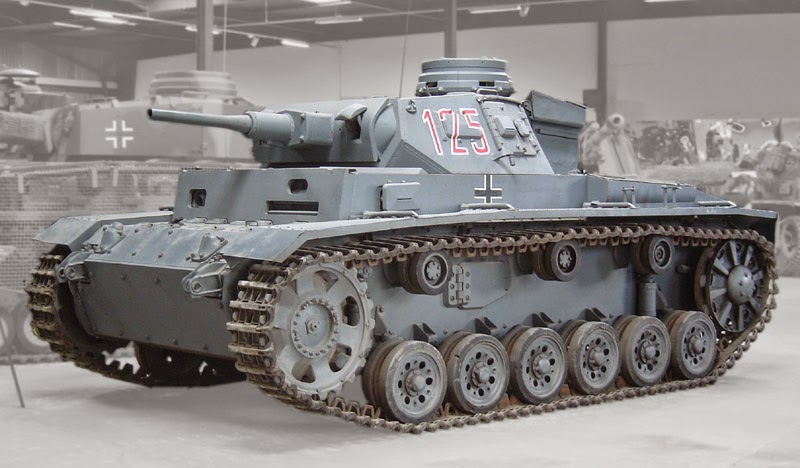
Panzerkampfwagen III (PzkPfw III) or SdKfz 141


ART BY Carlos de Diego Vaquerizo


It was envisaged in the mid-1930s that each German tank battalion would have three companies of relatively light medium tanks and one company of better armed and armored medium tanks. The former eventually became the Panzerkampfwagen III (PzkPfw III) or SdKfz 141, while the latter became the Panzerkampfwagen IV (PzKpfw IV) which was to remain in production throughout World War II. In 1935 the Weapons Department issued contracts for the construction of prototype vehicles against the lighter concept to Daimler-Benz, Krupp, MAN and Rheinmetall-Borsig. At an early stage it was decided to arm the tank with a 37-mm gun which would fire the same ammunition as that used by the infantry anti-tank gun, but provision was made that the turret ring diameter be large enough to permit the up gunning of the vehicle to 50 mm if this should be required.

Following trials with the prototype vehicles the Daimler-Benz model was selected, although the first three production models, the PzKpfw III Ausf A, PzKpfw III Ausf B and PzKpfw III Ausf C were built only in small numbers, differing from each other mainly in suspension details, In September 1939 the vehicle was formally adopted for service, and mass production was soon under way, The PzKpfw III was first used in combat during the invasion of Poland, The next production models were the PzKpfw III Ausf D and PzKpfw III Ausf F, the former with thicker armor and a revised cupola, and the latter with an up rated engine and only six road wheels. In 1939 it was decided to push ahead with the 50-mm model and this entered production in 1940 under the designation PzKpfw III Ausf F. This was followed by the PzKpfw III Ausf G version with similar armament but more powerful engine. For operations in North Africa the vehicles were fitted with a tropical kit, while for the proposed invasion of England a special version for deep wading was developed. The latter were never used for their intended role but some were successfully used during the invasion of the USSR in 1941.

The PzKpfw Aus H introduced wider tracks and a number of important improvements, The 50-mm L/42 gun was inadequate to cope with the Soviet T-34 tank, so the longer-barrelled KwK 39 L/60 weapon was installed. This had a higher muzzle velocity, and vehicles fitted with the weapon were designated PzKpfw III Ausf J. Many vehicles were retrofitted with the 50-mm gun, and by early 1942 the 37-mm version had almost disappeared from frontline service. The next model was the PzKpfw III Ausf L, which had greater armor protection, pushing its weight up to just over 22 tonnes, almost 50 per cent more than the weight of the original prototype. The PzKpfw III Ausf M and PzKpfw III Ausf N were fitted with the 75-mm L/24 gun which had been installed in the PzKpfw IV; a total of 64 rounds of ammunition were carried for this gun.

Production of the PzKpfw III was finally completed in August 1943. The chassis was also used as the basis for the 75-mm assault gun (Gepanzerte Selb stahrlafette für Sturmgeschütz 7.5 cm Kanone or SdKfz 142), of which a few were used in the invasion of France in 1941; production of improved SP guns on PzKpfw III chassis continued until the end of World War II. Other variants included an armored recovery vehicle, an armoured observation vehicle (Panzerbeobachtungswagen) and a command vehicle (Panzerbefehlswagen III), A total of 15,000 chassis was produced for both the tank and assault gun applications.

The layout of the PzKpfw III was basically the same in all vehicles, with the driver at the front of the hull on the left and the machine gunner/radio operator to his right. The three man turret was in the center of the hull, the commander having a cupola in the center of the roof at the rear. The engine was at the rear of the hull, and the suspension, which was of the torsion bar type from the PzKpfw III Ausf E, consisted on each side of six small road wheels, with the drive sprocket at the front and the idler at the rear; there were three track return rollers.

Thursday, April 16, 2015

Zugfuhrerwagen


The first vehicle to be produced in any numbers for the Panzerwaffe was, of course, the tiny Panzer I, which at the time was known as the MG Panzerwagen. Delivery of 318 of these had been made by August 1935, along with 15 of the Zugfuhrerwagen, which was later to become the Panzer III. One aspect of tank design which the Germans got absolutely right from the very outset was to identify the importance of radio communications. Although initially only the command tanks were fitted with radios that could both transmit and receive, the other vehicles were at last equipped with receiving radio sets, and this was a major advance upon the thinking of many of the countries which would come to oppose Germany. Throughout 1934 exercises continued with the experimental tank units and a number of other valuable lessons quickly became apparent, particularly the need for close co-operation between the air forces and the tanks on the ground. At this point the first serious tank tactics which were to bring so much success during the Second World War began to appear. It was soon obvious that the tanks needed to be employed on a relatively narrow front. A divisional front was estimated at about three kilometres, a great change from the wide fronts of the Great War. It was still obvious to the German High Command that the decisions which were being made, were based on theory, rather than practice. Germany - and indeed every other nation of the time - had no practical experience to draw upon, therefore a number of educated guesses were made.

In January 1936 General Beck reported to the High Command, his findings being based on a study of a French organisation. He was also very critical of the slow rise in production capacity which was hampering the development of the tank force. Interestingly, the debate about which tasks tanks were suitable for, and whether specialist machines had to be developed for each task, was already beginning to take shape. Beck’s report clearly stated that the three main tasks of the Panzers were supporting infantry, operating in units with other mobile weapons and, finally, combating other tanks. Beck himself was unable to come to a decision about whether a single tank should be developed with the capability to take on each of these purposes or whether a specialist vehicle should he designed for each purpose.

Ultimately the decision was that the light tanks would be used in a scouting role and that an infantry support tank would be developed which was ultimately to come to fruition in the form of the Panzer IV. This decision cast the Panzer III in the role of main battle tank. Amazingly the decision was taken that the 3.7cm gun which initially equipped the Panzer III would be sufficient for the battle conditions. The various types of German tank design were to cater for most eventualities on the battlefield. The Panzer I and II were earmarked for the reconnaissance role. The Panzer III was essentially designed for break-through and anti-tank operations and the Panzer IV was designed to provide close support for the infantry battling their way forward against dug-In positions. Almost from the outset the limitations of the design for the Panzer I were obvious. The armament in the form of two machine guns, was inadequate for most purposes on the battlefield. In addition the very thin armor gave protection only against rifle bullets: almost any battlefield weapon could penetrate the armor. More significant was the fact that the crew was comprised of only two men.

In October 1935 General Liese, head of the Heeres Waffenamt issued a report which gave the limitations of the tanks. He noted that the MG Panzerwagen (Panzer I), although fitted out only with two 7.9mm machine guns, could be adapted to attack armored cars and other light tanks if it was issued with special S.M.P. steel core ammunition. In the case of the MG Panzer II, it was noted that the muzzle velocity of the 2cm gun could penetrate up to 10mm of armored plate at a range of up to 700 metres. It was therefore decided that the Panzer II could engage armored cars with success, and was also fully functional for combat against tanks with approximately the same armor as itself. Liese noted that the tanks most likely to be encountered in large numbers in a war against the French were the light Renault Ml7 and Ml8 tanks, of which there were about three thousand operational in the French forces at the time. It was also thought that the Panzer II would be the equal of the Renault NC37 and NC31 tanks. Against the heavier French tanks, including the Char B, it was noted that the Panzer II was practically worthless. Despite these reservations large-scale delivery of the Panzer II was already in train and was expected to commence from 1st April 1937. As regards the new Panzer III, which was designed to be the main battle tank, it was obvious that, even in 1935, Liese was already beginning to have reservations about the effectiveness of the 37mm gun. Originally the 37mm L/45 had been planned for this vehicle, but it was urged that the experimental tanks be upgraded to include the L/65 version, which gave a much higher muzzle velocity and some real prospect of penetrating the 40mm thick armored plate of the new French medium tanks. With this in mind it was obvious at this stage that a 50mm gun would be a better proposition for the Panzer III; however the addition of the larger gun would demand a significant increase in the diameter of the turret which would in turn mean radical redevelopment of the chassis. Given the pressures of time and the need to equip the formations quickly Liese came to the conclusion that the 37mm L/65 was the favoured route, although it is interesting that the limitations of its design had already been noted.

The PzKpfw III (Panzerkampfwagen III Sd.Kfz.141)was therefore designed to be the Wehrmacht’s main combat machine and was developed by Daimler-Benz in the mid 1930s under the pseudonym Zugfuhrerwagen, which means platoon commanders’ truck. The first prototype of the PzKpfw III was produced by Daimler-Benz in Berlin 1936.

Following numerous modifications, the Ausf. A (1-Serie) appeared in May 1937 and : by the end of 1937, 15 were produced. Only 8 of the Ausf. As were fully armed and the unarmed machines were used for further testing and modification.

Daimler-Benz produced 15 Ausf. Bs (2-Serie) in 1937, 15 Ausf. Cs (3a-Serie) by the beginning of 1938; it continued by introducing the next variant the Ausf. D (3b-Serie), 55 of which were produced in 1939. Of the entire Ausf. Ds production run, only 30 were armed.

All early models of the Panzer III, including the Ausf A/B/C/D were pre-prototypes of the whole series and were unsuitable for large scale production. Every new prototype was a marginal improvement on the last. Each model featured a different type of suspension, a variation on the Maybach DSO, such as the HL 108 TR engine. Only a relatively few vehicles saw combat in the early stages of the war; the Ausf. D saw service during fighting in Denmark and Norway in May 1940 and in Finland in 1941/42. In February 1940, the remaining Panzer Ills Ausf D were handed over to NSKK for training purposes.

The first Panzer III model to go into anything like full-scale production was the Ausf E of which 96 were produced. With a thicker 30mm frontal armor, a Maybach HL 120TR engine and new suspension and gearbox raising its weight up to 19.5 tonnes, the Ausf. E was the best machine so far.

By 1940, and during the ‘E’ model production, it was decided to fit all models with a 50mm gun as standard. The L/42 gun was fitted on Ausf. E, F, G and H. In an ill-considered deal which would come back to haunt them, the Germans actually sold Two PzKpfw III tanks to the Soviet Union in the Summer of 1940 under the Ribbentrop-Molotov treaty. They were tested by the Soviets alongside the early T-34/76 tanks. The German PzKpfw III proved to be faster than Soviet T-34/76 and BT-7, reaching a maximum speed of 69km/h. However it was obvious that the Soviet T-34 was far superior in armor protection and armament even if lacking in esthetics and overall mechanical reliability, when compared to German PzKpfw III tanks. The PzKpfw III was also found to be far less less noisy than Soviet T-34. It was discovered that the T-34 could easily be heard from a distance of 450m, while PzKpfw III could only be heard when it approached to within 150-200m.

From 1941, Hitler insisted that the more powerful L/60 (50mm) gun was fitted on Ausf J-1. In 1942, 104 Ausf J’s were converted to Panzerbefehlswagen III (Command Tanks) and in April 1943, 100 Ausf. M’s were converted by Wegmann into the Flammpanzer (Flamethrower Tanks); designed to fight in urban areas such as Stalingrad. Although the models produced never actually reached Stalingrad, they did see service on the Eastern Front. Additionally, many Ausf. Ms were converted into the Sturmgeschütz III or the Ausf. N.

The Panzer III provided the main battle tank for the Panzer Divisions in the early years of the war, yet its production was slow and stopped altogether in August 1943, in 1943/44, the Panzer III prototypes were fitted with dozers and were used to clean up the streets of war-torn cities.

THE EVOLUTION OF THE PANZER III Part II


In October 1940, the Ausf H (7-serie) entered production. It was produced by MAN, Alkett, Henschel, Wegmann, MNH and MIAG until April of 1941 with 308 produced (chassis numbers 66001-66650). The Ausf H featured a newly designed turret to mount a 50mm gun with a single 30mm armor rear plate. Armor protection ranged from 10mm to 30mm, but hull, front and rear, as well as the superstructure front had 30mm armor plates bolted on to them increasing the protection. The increase in armor protection in the Ausf H neutralized the threat of British 2pdr, Soviet 45mm and American 37mm anti-tank guns. The new six speed Maybach SSG 77 gearbox replaced the previously used Variorex. In addition, the suspension system was slightly modified and new sprocket and idler wheels were used in the Ausf H. Consequently, because of the weight gain to 21.8 tons, due to the increase in armor protection, torsion bars were strengthenedd. Originally, the Ausf H was armed with a 50mm KwK 38 L/42 gun and two MG 34 machine guns, but in 1942/43, they were rearmed with a50mm KwK 39 L/60 gun.

Ausf E, F, G and H were designated as Panzerkampfwagen III Ausf E, F, G and H / Sd.Kfz.141. As of May 10th 1940, the Panzertruppe had only 381 Panzer III models in service, but 135 were lost during the Blitzkrieg in the west.

In March 1941, the last Sd.Kfz.141 and the first Sd.Kfz.141/1 Panzerkampfwagen III tank - Ausf J (8-serie) entered production. It was produced by Daimler-Benz, MAN, Alkett, Henschel, Wegmann, MNH and MIAG until July 1942 with 2616 produced (chassis numbers 68001-69100 and 72001-74100). The Ausf J had its armor protection significantly improved and it ranged from 10mm to 50mm. The increase in armor was accompanied by the installation of the new driver’s visor (Fahrersehklappe 50) and a ballmount (Kugelblende 50) for a 7.92mm MG 34 machine gun in the hull. A new type of front access hatch was installed along with new air intakes on the hull front. From April 1942, 20mm spaced armor was added to the gun mantlet and/or superstructure front. 1549 vehicles produced from March 1941 to July 1942 were armed with a 50mm KwK 38 L/42 gun and two MG 34 machine guns. Those vehicles were designated as PzKpfw III Ausf J / Sd.Kfz.141. 1067 vehicles produced from December 1941 to July 1942, were armed with 50mm KwK 39 L/60 and two MG 34 machine guns. Those vehicles were designated as PzKpfw III Ausf J / Sd.Kfz.141/1. The only difference between these models was the main armament and ammunition stowage for 84 rounds in contrast to the previous 99 rounds. When encountered in North Africa, the British nicknamed the 50mm L/60 Ausf J the "Mark III Special". The 50mm L/60 gun was a significant improvement over the original 37mm gun, although it was still inadequate to deal with American M4 Sherman and Soviet T-34/76 tanks. In 1941/42, there was an unsuccessful attempt by Krupp to mount the Ausf J with Panzerkampfwagen IV Ausf G’s turret to create a new Panzerkampfwagen III variant designated Ausf K.

From August to November 1942, 81 Ausf J tanks were produced as command tanks - Panzerbefehlswagen III mit 5cm KwK L/42 / Sd.Kfz.141. From March to September 1943, an additional 104 Ausf J were converted as well. The vehicle was the basic Ausf J tank but it lacked a hull machine gun and carried less ammunition (75 rounds). It was fitted with additional radio equipment and periscope.

In June 1942, the Ausf L tank entered production. 653 were produced by Daimler-Benz, MAN, Alkett, Henschel, Wegmann, MNH and MIAG until December 1942 (chassis numbers 74101-75500). The Ausf L was armed with a 50mm KwK 39 L/60 gun and two 7.92mm MG 34 machine guns. Externally it was almost identical to the late model Ausf J as it was developed by modifying it. The main difference was the new torsion bar gun counter balance, which replaced the original coil spring gun recoil mechanism. Armor protection of the front turret was increased from 30mm to 57mm and 20mm spaced armor was installed on the superstructure front, and in many cases on the gun mantlet. The design of the vehicle was simplified as the rear deck was modified (air-intakes and hatches) and early in production the hull escape hatches, the loader’s vision port on the mantlet and turret side ports were removed. The Ausf L was also mounted with a new special system to transfer heated engine coolant from one vehicle to another. A single Ausf L was mounted with an experimental 75/55mm tapered-bore KwK0725 gun and was designated as PzKpfw III Ausf L mit Waffe 0725. Vehicles send to North Africa were equipped with additional air filters, modified oil filters, a different cooling fan reduction ratio and were designated as Ausf L(Tp). The Ausf L was also first to be mounted with an anti-aircraft machine gun mount (Fliegerbeschussgerat 41/42) on the commander’s cupola. This became standard on all new PzKpfw III tanks and was mounted on older models during service. Many were mounted with 5mm hull and turret armor skirts (Schurzen).

From October 1942 to February 1943, 250 new Ausf M (10-serie) tanks were produced by Wegmann, MIAG, MAN and MNH (chassis numbers 76101-77800). The Ausf M was a late production model Ausf L mounted with new wading equipment allowing wading up to depth of approximately 1.3m, in contrast to the previous 0.8-0.9m. This led to all air inlets and outlets as well as other openings and joints being sealed, while a modified muffler with closure-valve was installed high on the hull rear. The new system was developed and a modified version was used in Tauchpanzer III submersible wading tanks. The hull rear mounted rack of five smoke generators was replaced by three 90mm NbK dischargers mounted forward on both sides of the turret. The Ausf M just as the Ausf L was armed with a 50mm KwK 39 L/60 gun and two 7.92mm MG 34 machine guns. Vehicles produced in 1943 were factory mounted with 5mm hull and turret armor skirts (Schurzen). Large number of Ausf M were converted to either Sturmgeschütz III or Ausf N.

GERMAN TANK RUBBER ANALYSIS
Analysis by British engineers of samples of natural and artificial rubber taken from the PzKw 3 tanks discloses some interesting points which are worth recording.

Two very similar articles, i.e. a vision forehead pad and a cupola pad of a 1940 model of this tank proved to be very different when analyzed. The former was made of natural rubber and was secured to the metal by the brass plating process. The cupola pad, on the other hand, was made from synthetic rubber and was attached to the metal by an adhesive paint. These samples confirm the previous supposition that the Germans have not yet learned how to make an efficient joint between synthetic rubber and metal.

The most interesting sample, however, was a section of a bogie wheel tire from a PzKw 3 tank (probably 1942). This sample proved to be made of synthetic rubber. This is said to be the first evidence received by the British authorities of this material being used by the Germans for solid tires. It seems to show that the Germans have made sufficient technical progress to overcome the heating difficulties previously arising when synthetic rubber was used for this type of work. The method of adhesion to the metal band was by means of an intermediate layer of hard, probably natural rubber.

THE EVOLUTION OF THE PANZER III Part I


Trials and tests of new prototypes took place from 1936 to 1937 on testing grounds in Kummersdorf and Ulm. They resulted in the Daimler-Benz design being chosen for full-scale production and in early 1937, Waffenamt ordered Daimler-Benz to produce the first series (0-Series) of their design.

Krupp’s ZW prototype, designated as MKA, featured leafsprings and bogie wheel mountings type of a suspension. In turn, many features of this vehicle were used in the design of Panzerkampfwagen IV, which was designed by Krupp.

The PzKpfw III design was composed of four sections - hull, turret, and front superstructure with the opening for the turret and rear superstructure with the engine deck. Each section was of a welded construction and all four were bolted together. The hull was divided into two main compartments divided by a bulkhead. The front compartment housed the gearbox and steering mechanism, and the rear one both the fighting and engine compartment. Basic hull, turret, superstructure and crew layout remained unchanged throughout the production life of Panzerkampfwagen III series.

After modifications, the first Panzerkampfwagen III Ausf A (1-Serie) was produced in May of 1937 by Daimler-Benz, with total of 10 produced until the end of 1937 (chassis numbers 60101-60110). Some sources state that as many as 15 were manufactured. Only eight Ausf As were armed (and equipped units of 1st, 2nd and 3rd Panzer Division and took part in the Anschluss, the take-over of Sudetenland and the Polish Campaign) and other unarmed Ausf As were used for further testing.

In 1937, the Ausf B (2-Serie) was produced by Daimler-Benz with total of 15 produced (chassis numbers 60201-60215). A number of Ausf Bs saw service during the Polish Campaign. In October of 1940, five Ausf B tanks were modified and used as prototypes of Sturmgeschutz III series.

In June of 1937, the next variant Ausf C (3a-Serie) was produced by Daimler-Benz and its production ended in January of 1938, again with total of 15 produced (chassis numbers 60301-60315). A number of Ausf Cs saw service during the Polish Campaign.

In January of 1938, the next variant Ausf D (3b-Serie) was produced by Daimler-Benz and its production ended in 1939 with total of 55 produced (chassis numbers 60221-60225 and 60316-60340). Only 30 Ausf Ds produced in two groups of 15 were armed, and another 25 unarmed Ausf Ds were used for further testing. A number of Ausf Ds saw service during the Polish Campaign and in Norway.

The warly models of Panzer III (Ausf A, B, C and D) were pre-prototypes of the entire series produced exclusively by Daimler-Benz. All were unsuitable for large-scale production but each new model was considered an improved version of the previous one. Each model featured different type of suspension e.g. Ausf A - individual coil springs, Ausf B - two sets of leaf springs, Ausf C - three sets of leaf springs and Ausf D - angled leaf springs.

Ausf A, B, C and D were powered by 250hp petrol Maybach HL 108 TR engines with a 5 or 6 speed Zahnradfabrik gearbox. All early models were armed with 37mm KwK 35/36 L/46.5 gun and three 7.92mm MG 34 machine guns (two mounted co-axially beside the main armament in the turret and one in the hull). Their armor protection ranged from 5 to 15mm, offering protection only against anti-tank rifles and machine gun fire. The reason behind the inadequate armor protection was a result of Daimler-Benz keeping the vehicle in its designated weight range of 15 tons. Some of early models were up-armored and had their maximum armor protection increased to 30mm. Ausf A, B, C had simple drum shaped "dustbin" commander’s cupolas, while Ausf D had cast cupolas similar to that of the PzKpfw IV Ausf B.

A few of the early Panzer IIIs saw actual combat (with units of 1st, 2nd and 3rd Panzer Division) during the Polish Campaign, others were troop tested (1937-February 1940). In February of 1940, existing number of early Panzer IIIs was handed over to NSKK for training purposes. Afterwards, only a few Ausf D saw service with PzAbt zbV 40 (along with PzKpfw NbFz VI) during fighting in Norway in April/May of 1940, followed by service with PzAbt zbV 40 in Finland, 1941/42.

Raw Materials Used in Production of PzKpfw III:
•Steel: 39000.00kg
•Tin: 1.40kg
•Copper: 60.10kg
•Aluminium: 90.40kg
•Lead: 71.10kg
•Zinc: 49.10kg
•Rubber: 125.00kg

In December of 1938, the Ausf E (4-serie) entered production, and 96 were produced by Daimler-Benz, Henschel and MAN when production ended in October of 1939 (chassis numbers 60401-60496). It was the first PzKpfw III that was produced in any significant number. The basic design remained unchanged from its predecessor, but it featured a new independent torsion bar suspension, designed by Ferdinand Porsche for the automotive industry in 1930s. It was composed of six roadwheels and three return rollers. The Ausf E was armed with a 37mm KwK 35/36 L/46.5 gun and three 7.92mm MG 34 machine guns (two in the turret and one in the hull). Its armor protection ranged from 12 to 30mm. During production, escape hatches were installed on both sides of the hull and a vision port was added on the superstructure side for the radio-operator. The driver’s visor was provided with an upper and lower sliding shutter, which could be closed together. Also two-piece side hatches were installed in the turret. Unlike its predecessors, the Ausf E was powered by new 300hp petrol Maybach HL120TR engine with a new Maybach Variorex 10 speed gearbox. It was also heavier than all previous models, which were in the 16 ton range but Ausf E weighted 19.5 tons. From August 1940 until 1942, all Ausf E tanks were rearmed with a 50mm KwK 38 L/42 gun mounted in an external mantlet also housing one MG. At the same time, armor protection was increased by the installation of 30mm armor plates to the hull, front and rear, as well as the superstructure front. During service, the number of Ausf E tanks was also reworked to Ausf F standard.

In September 1939, another new variant, the Ausf F (5-serie) entered production. Until July 1940, 435 were produced by Daimler-Benz, Henschel, MAN, Alkett and FAMO (chassis numbers 61001-61650). It was a refined version of the Ausf E and it did not feature any significant modifications or changes other than an improved Maybach HL120TRM engine and modified upper hull nose (with air intakes). The first 335 Ausf F tanks were armed with a 37mm KwK 35/36 L/46.5 gun and three 7.92mm MG 34 machine guns (two in the turret and one in the hull). The last 100 tanks were factory armed with a 50mm KwK 38 L/42 gun mounted in an external mantlet housing one MG. Ausf F vehicles were fitted with a hull rear mounted rack of five smoke generators remotely released from the turret. Some vehicles were also mounted with a stowage box at the rear of the turret. From August 1940 until 1942, all 37mm Ausf F, just as Ausf E tanks, were rearmed with 50mm KwK 38 L/42 guns. They also had their armor protection improved at the same time as Ausf E tanks. Only 40 Ausf F tanks with 50mm KwK 38 L/42 guns were rushed into service before the end of the French Campaign and saw little or no combat. There is still controversy surrounding this as it is reported that the first PzKpfw III armed with 50mm guns entered production in July of 1940. The first production of Sturmgeschutz III assault guns / tank destroyers were based on the Panzerkampfwagen III Ausf F chassis and components. In 1942/43, a number of Ausf F tanks were rearmed with a 50mm KwK 39 L/60 gun. Rearmed and up-armored Ausf F tanks remained in service as late as June of 1944 (e.g. 116th Panzer Division in Normandy).

An interesting fact is that the study report of the captured PzKpfw III Ausf F made by the British in 1942, was then sent to United States Army Ordnance Department where it was decided to utilize a copy of German torsion bar suspension system in future American tanks (e.g. M18 Gun Motor Carriage, M24 Chaffee, M26 Pershing etc.).

In 1940/41, attempts were made to standardize the production of Panzer III and Panzer IV. A few prototypes based on the Panzer III Ausf G/H with new large overlapping roadwheels and FAMO suspension were produced - PzKpfw III Ausf G/H mit Schachtellaufwerk. Since 1940, prototypes were used for testing and training purposes. Further development was halted and in 1943/44, prototypes were fitted with dozers and were used to clean up the streets of bombed cities. This suspension was later adopted in Tiger and Panther.

From April 1940 to February 1941, 600 new Ausf G (6-serie) tanks were produced by Daimler-Benz, Henschel, MAN, Alkett, Wegmann, MNH and FAMO (chassis numbers 65001-65950). The Ausf G was a slight improvement over previous Ausf E and Ausf F tanks. Some 50 Ausf G tanks were armed with 37mm KwK 35/36 L/46.5 guns mounted in an internal mantlet, while the rest were armed with a 50mm KwK 38 L/42 gun mounted in an external mantlet. Both 37mm and 50mm tanks had additional two MG 34 machine guns, one in the turret and another in the hull. Armor protection ranged from 12mm to 30mm, although the majority of the protection ranged from 21mm to 30mm. Also a new pivoting visor for the driver (Fahrersehklappe 30) was installed. The turret was modified and mounted on the roof with a fan exhaust and one signal port was eliminated. Mid-production vehicles were mounted with the new type of commander’s cupola as used in the PzKpfw IV Ausf E, F and G, which became standard on all later models of PzKpfw III. Late production vehicles had wider 400mm tracks instead of standard 360mm tracks. The Ausf G was the first to be mounted with the "Rommelkiste" (Rommelbox) - turret mounted storage bin (Gepack Kasten), which then became the standard on all PzKpfw IIIs. From August 1940 until 1942, all 37mm Ausf G tanks just as Ausf E and F tanks were rearmed with the 50mm KwK 38 L/42 gun. Vehicles sent to North Africa were equipped with additional air filters and a different cooling fan reduction ratio. They were designated Ausf G(Tp), Tp being short for Tropisch / Trop / Tropen - tropical. A small number of Ausf G tanks remained in service as late as September 1944.