Showing posts with label Technical. Show all posts

Tuesday, August 11, 2015

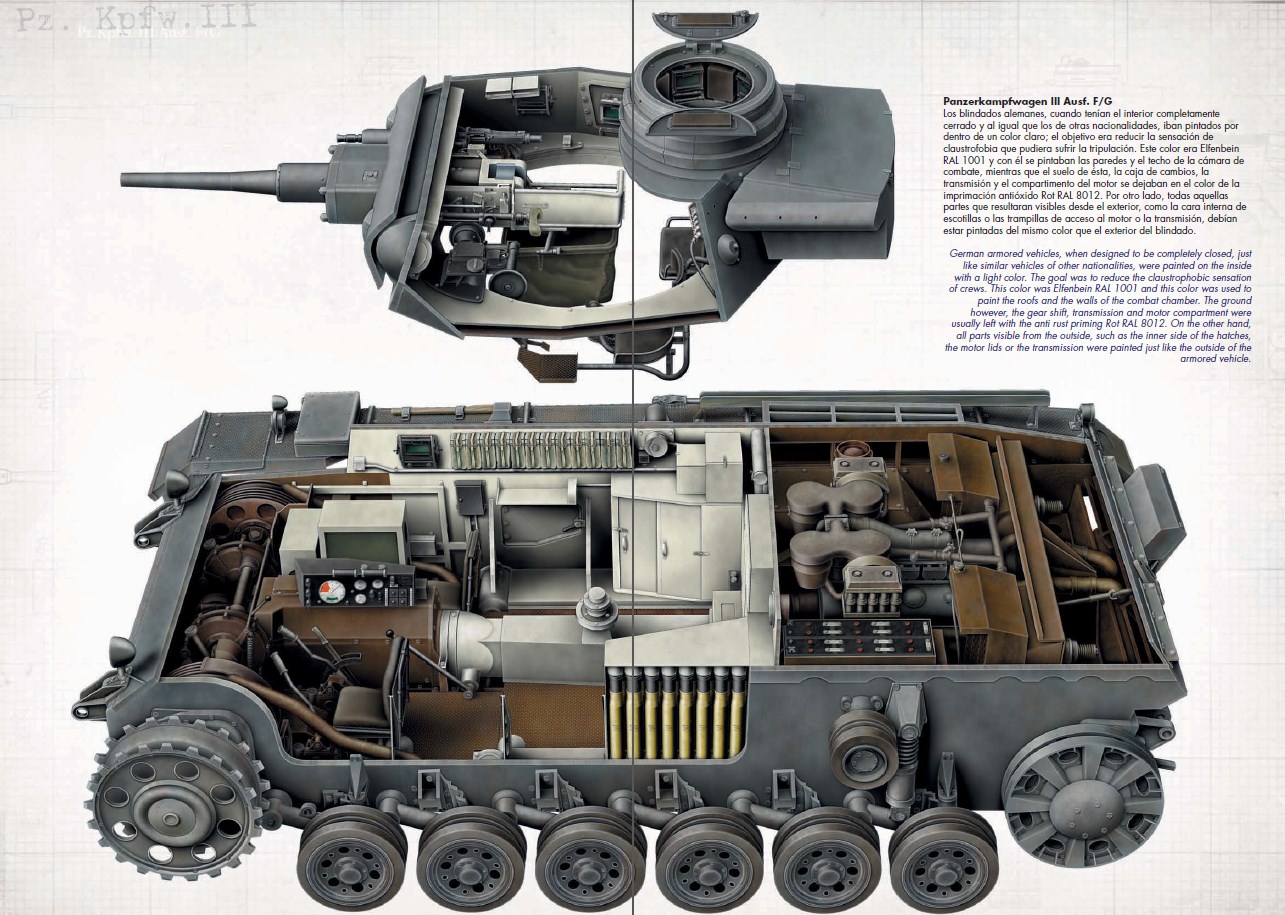
Cutaway - Pz.III


ART BY Carlos de Diego Vaquerizo


The Panzer III crew consisted of five men with two in the front of the hull including a driver at the left and a radio operator/hull machine gunner at the right. Up in the turret, the gunner sat to the left of the main weapon in typical German style, a loader worked the gun on the right side, and the commander sat elevated at the rear with the use of a cupola over his head for battlefield observation. Both the gunner and commander sat in padded seats suspended from the turret ring, rotating with the gun. But the loader had the use of a small fold down seat attached to the back firewall and typically worked standing up on the hull floor with his seat stowed. Most of these Ausf. E and F panzers were manufactured between 1938 and 1940 by Daimler-Benz, Maschinenfabrik-Augsburg-Nuernberg (MAN), and Henschel & Sohn, and together these firms produced 96 Ausf. E and 435 Ausf. F vehicles. The basic interior layout of the Pz. III would remain unchanged throughout the remainder of the production run but most of the major components would continue to improve, particularly up in the turret, as experience was gained in combat.

Unlike the early 3.7cm gun, the 5cm weapon and coax were protected behind an external mantlet. But in these models there were two viewing flaps in the mantlet, one on each end, and both of them are visible here. The additional right flap allowed the loader the same unrestricted view out the front of the tank as the gunner had. Notice the lead weight attached to the rear of the recoil guard to help balance the barrel heavy weapon.

The 5cm gun fired three ammo types. The high explosive (HE) was known as Sprenggranate 38 (Sprgr. 38), which was nose fused for impact detonation. The second type was an armor piercing capped shell of the typical German penetrating and bursting type called Panzergranate 39 (Pzgr. 39). The piercing cap on the end of the projectile helped reduce shattering upon contact with the target. The third type was Panzergranate 40 (Pzgr. 40) and this was a light weight projectile with a very heavy tungsten carbide core. Sometimes known as armor piercing composite rigid (APCR), this projectile reached a very high muzzle velocity at close ranges due to its light weight, but its velocity decreased rapidly at distance for the same reason. Because tungsten was at a premium in Germany, this shell was never offered to tankers in abundant quantity, but when battling at close quarters the Pzgr. 40 was a powerful armor piercing shot.

The Pzgr. 39 was one of a number of German bursting AP shells (called "Supercharged" by the Allies) which were particularly effective against Allied tanks where ammo was often stored unprotected inside the hull or turret. This was because the Pzgr. bursting charge detonated just after penetration, causing extensive internal fires and ammunition explosions with subsequent serious injury or death to the crew. On the other hand, Panzer III ammo rounds were stored in armored cabinets (4 to 6mm thick) below the turret ring, and Allied AP rounds that managed to penetrate the external armor skin were less likely to set them off. This was because the damage caused by most allied solid AP shells was restricted to the kinetic energy left in the round after penetration.

The next major changes in the evolution of the Pz. III centered on yet another increase in armor thickness to 30mm, requiring a new driver's visor 30 and an improved KFF2 periscope in the new Ausf. G tanks. With an improvement in the turret wall design to provide more room inside, an improved cupola was also added, the same cupola that was also mounted on later Pz. IV tanks. As with the mid production cupola mentioned earlier, the late style cupola required only one lever to open and close the upper and lower shutters that protected each of the cupola's five viewing blocks. But now the shutters were smaller, only the width of the view opening, and the operating lever inside was made to fit into détentes that fixed the shutters fully opened, half opened, and fully closed. Although the first batches of these new Ausf. G and J tanks were originally built with the 3.7cm guns, all later vehicles of these types were fitted with the KwK38 L/42 5cm weapons. By the end of 1942, most of the earlier Panzer III tanks that were still in service had been updated with the 5.0cm gun and very few photos show vehicles with the smaller caliber weapon from then on.

The short barreled 5.0cm L/42 was not powerful enough to penetrate many of the Soviet tanks they encountered during their Blitz into Russia and the longer KwK39 L/60 gun was substituted for the shorter weapon at the factories during the Ausf. J production run. Although the gun breech of both the L/42 and L/60 guns is identical from inside the vehicle, the longer ammo rounds of the later gun required some rearranging of storage in the hull and a reduction of numbers. Those vehicles with hull side escape hatches could store around 84 of these longer rounds while later Ausfs., with the hatches deleted, had room for 98.

Thursday, April 16, 2015

How effective were AT rifles against the Pamzer III?


The case of the Pz IIIs. 

All the Pz IIIs with 37mm guns had only 30mm of front armor. The first 50L42 armed model, the G, had the same. The first to uparmor, to 30mm plus 30mm additional bolted on the front hull only, was the H model. The turret was still 30mm, at around 15 degrees slope (the G and H mantlets were somewhat thicker, 37mm). Both Gs and Hs were made between the fall of France and the invasion of Russia, with twice as many of the G model produced as Hs. 

By the time of the invasion, production of the J model with the 50L60 gun had begun, but most of the existing fleet were the older models. This model had 50mm front plates factory built, and a 50mm mantlet, but the rest of the turret front was still 30mm. The J series had the largest production run of any of the letters, as production began to ramp in 1942. They were produced from before the invasion until a year after it. 

The last year of Pz III production, as tanks rather than StuG that is, were the L-N versions, from mid 1942 to mid 1943. These had 57mm turret fronts, 50mm base front armor elsewhere, and in addition 20mm additional plates bolted on to the upper front hull and gun mantlet. Through this whole uparmoring process, the turret sides and rear, and the hull sides, remained 30mm only. 

The final production vehicle of the Pz III series was the StuG. The early StuG had the 75L24 gun, same as in the Pz IV, and had 50mm of front armor - like the Pz III J model - with the same 30mm sides naturally, since they used the same chassis as the Pz III tanks. By late war standards, not many of these were produced. 

The first upgunned StuGs, the F models, had 75L43 guns, and originally the same armor as before. The same expedient of bolting on extra armor plate was used, to thicken the front from 50mm to 50mm+30mm (going from 2 inches up to 3 inches thick, basically). The gun mantlet was not uparmored and remained 50mm. Late model F series, toward the end of 1942, had the 75L48 and the extra bolted armor. 

The last production model of the StuG III, the G model, was the type produced from 1943 to the end of the war, and in the late war by far the most common type. Everything you'd see in CMBO is this model. It had 80mm front armor factory built, and the 75L48 gun. The sides are still the same 30mm as the original Pz III had all around - plus skirts.

The side armour of the StuG and Panzer IV were just as weak in 1944 and 1945 as they were in 1943 when Schürzen was introduced. The AT-rifle also remained effective against lightly armoured vehicles like the SdKfz 251, effectively an infantry fighting vehicle operating against Soviet infantry.

According to Steven Zaloga, approximately 1/2 million AT-rifles were produced during the war with 37.000 still being turned out in 1944 and the Soviet Rifle division nominally had 111 such weapons in its inventory in June 1945 (down from 279 in 1942).


Of course, Schürzen were originally tested against direct HE fire as well, and that threat hadn't disappeared either.

KPB - AT Machine gun (1944) Penetration 32 MM at 90 degrees at 500 meters. ROF 70/minute. 
 
PTRD - (1941) AT rifle Penetration 37mm at 300 meters. 

PTRS (1941) AT rifle. ROF 15/minute, Penetration 35mm at 90 degrees at 300 meters, 25mm at 500 meters. Germans used captured ones as PzB 783(r). Could penetrate 50mm vertical armor at 100 meters. (PzIV had 50mm vertical front armour) 

So at very close distances these could be quite deadly to tanks like PzIII and PzIV.

The official design requirement was that at a range of 500m it should penetrate 20mm of case-hardened armour at 70 degrees.

The BS.41 bullet used in the ATRs had a tungsten-carbide core and was a very good performer. I have figures of penetration (at 60 degrees in all cases) of 30mm/100m, 27.5mm/300m and 25mm/500m.

The penetration data is for 60° from vertical, or 60° from horizontal (30° from vertical).

Penetration loss with range looks very small for such a light weight round.
60 degrees from horizontal.

The 14.5 fires a heavy bullet which probably doesn't slow down that much up to 500m, but I agree that the fall-off in penetration looks low. The figures are from a secondary source on anti-tank rifles. If anyone has a primary source I would be interested.

The 14.5mm API had a small-arms style of bullet, i.e. with a complete streamlined jacket (in steel, coated with gilding metal or (later) zinc) and with the AP core filling most of the bullet. There was a gap between the blunt-nose core and the jacket tip and this was filled with incendiary material. This design was copied by the US for their .50 cal M8 API round used in late-WW2 and Korea aircraft guns.

In the BS.41 the core was tungsten carbide and the bullet short and flat-based. In the BS-32 (which may have followed it into production) the core was steel and the bullet longer and boat-tailed.

My source is Labbett & Brown's Technical Ammunition Guide 2/4 on Soviet 12.7mm and 14.5mm ammo - very good, lots of sectioned drawings!

I suspect that the main advantage of the plates was that penetrating them might cause the bullet to tumble and hit the armour side-on, greatly reducing effectiveness.

The Luftwaffe found out that just penetrating 3mm alloy aircraft skin before hitting armour would reduce effectiveness of AP bullets by up to 30%.

Thoma - or Drahtgeflechtschürzen were adopted in September '44, starting with Fgst.Nr. 92301, so any unit receiving Pz IV Ausf. J after this date should theoretically have them, although the usual first in/last out process of assembling tanks may throw a spanner or two in the works here.


The small-caliber AT-rifles used early in the war (7.92mm etc.) was not very effective. The Soviet 14.5mm PTRD and PTRS were different beasts all together. They were effective against lightly armoured vehicles like the German SPWs (SdKfz 250/251) and sufficiently powerful to cause the Germans to adopt "Schürzen" to protect the lower hull of the Panzer III, IV and Sturmgeschütz.
The entire Panther project was nearly cancelled because the lower hull armour was considered to weak to withstand (future?) Soviet AT-rifles. Had it not been possible to put Schürzen on the Panther, it would have been replaced by the Panther II! (See Jentz: "Panther..." p. 35 and 53)

The German problem with the Soviet AT-rifles was not that they were very effective against German tanks - the problem was that on a good day with a lucky gunner, one of these dirt-cheap and primitive weapons could knock out a 100.000 Reichmark tank. That was not acceptable and the Germans put a lot of design effort into conquering this problem.

Of course, the AT-rifles would also be effective against vision slots, periscopes and other weak spots and openings in the tanks armour.
  
One would think that expanded metal grating would be not much harder to produce than plate, while providing the weight and material savings of wire mesh. Or was such a product not part of the German industrial "toolkit" in the 1940's?


Sound dumb does it not? Well, it is

It was not the wire-mesh shields that posed problems, it was the brackets attaching them to the hull. None had been developed at this time (February 1943) and designing them would delay the issue of Schürzen. (Jentz/Spielberger: "Begleitwagen.." p. 198)

When Schürzen were first tested in 1943, both wire-mesh and plate were used. Results showed that both were equally effective in stopping AT-rifle rounds and HE. It was decided to use plates because wire-mesh was more complicated to produce and the facilities for producing plates were already there (see Jentz & Spielberger: “Begleitwagen” and Spielberger: “Sturmgescütze...”)


Schurzen Side Skirts
The previously mentioned Schuzen side-skirts became a topic of discussion during the Fuhrer's conference on 6 and 7 February 1943. Hitler was quite in agreement with mounting skirts on the Panzer III, IV and Sturmgeschutz to provide protection against Russian anti-tank rifles. Test firings on Schurzen protective skirts (wire and steel plates) were reported on February 20, 1943. Firing tests utilizing the Russian 14.5mm anti-tank rifle at a distance of 100m (90 degrees) showed no tears or penetration of the 30mm side armor, when protected either by plates or wire mesh. When testing was conducted with the 75mm high explosive shell (Charge 2) from a field gun, there was no damage to the sides of the hull armor when protected by the wire or plates. Wire mesh and plates had indeed been penetrated and even torn away, but, they still remained usable.
The decision to utilize the plates as opposed to the wire mesh (although both had proven effective and the mesh was lighter) was based on the fact that the wire mesh required the design of a new mount, which would have required additional time to be developed.
Additionally, the procurement of wire mesh for the side skirts was difficult. The skirts were not tested against shaped charges, nor were they intended as protection against shaped charge (HEAT) shells.
On March 6 1943, Hitler indicated that he was satisfied with the favorable results of the firing tests against the Schurzen side skirts. In addition to outfitting all newly produced Sturmgeschutz, Panzer IV and Panthers with side skirts, all armored vehicles of these types currently deployed and those undergoing maintenance, were to be backfitted with them. The schedule for fitting Schurzen was to be expedited.